DAIM TECHNOLOGY · PHYSICAL AI PLATFORM

Simulate Before You Invest. Optimise Before You Deploy.

xSIM — Simulation for System X

xSIM is a high-speed Discrete Event Simulation platform designed to model complex manufacturing and intralogistics operations, evaluate automation strategies and support data-driven system design.

xSIM accelerated predictive simulation platform
xSIM high-speed Discrete Event Simulation of factory operations

Core capabilities

What xSIM delivers.

  • High-Speed Discrete Event Simulation (DES)
  • What-If Scenario Analysis
  • Robot Fleet Sizing
  • Production Throughput Prediction
  • Material Flow Simulation
  • Layout & Routing Validation
  • Investment Feasibility Analysis
  • Operational Strategy Optimisation
  • Manual and Automated Process Modelling
  • Simulation-Based Risk Assessment

How it works

Inside xSIM.

01

High-speed simulation

Powered by Discrete Event Simulation, xSIM simulates complex manufacturing and intralogistics systems tens to hundreds of times faster than real-world operations, rapidly evaluating tens of thousands of scenarios to identify the optimal operational strategy.

02

AI-powered robot orchestration

xSIM incorporates DAIM’s AI-powered robot orchestration module to manage complex logistics robot operations within a unified control framework, evaluating congestion-free routing and efficient fleet operations before deployment.

03

Tailored system integration

xSIM can be configured to match each customer’s operational requirements and integrated with existing systems, enabling simulation scenarios tailored to each production environment, ready for deployment.

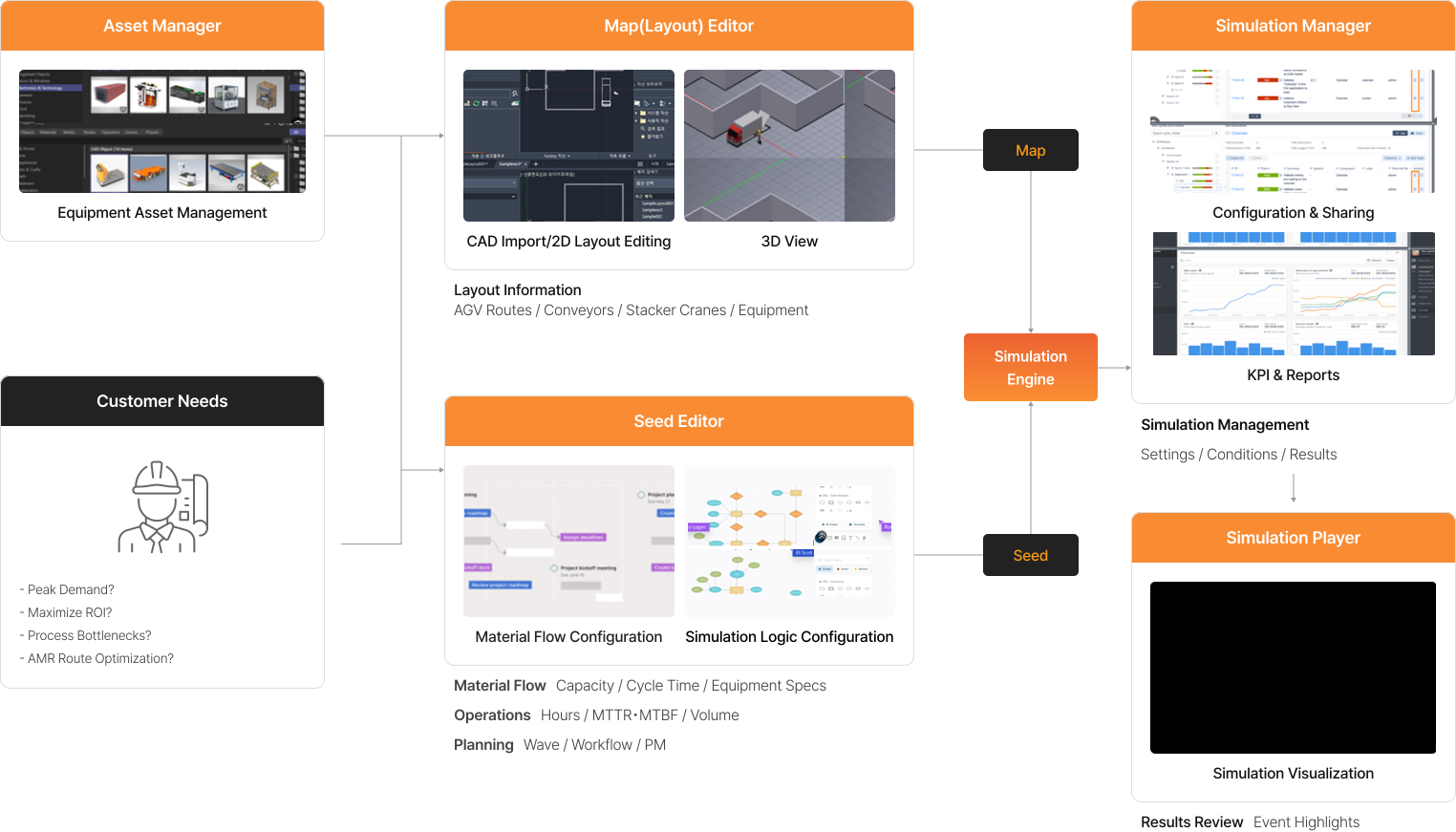
Integrated xSIM workflow from design to validation

DAIM Technology Project References

Proven results from global manufacturing leaders.

Large-Scale AGV, AMR & OHT Deployment

Challenge
When deploying large-scale AGV, AMR or OHT systems, it is difficult to predict whether target KPIs such as throughput and lead time can be achieved, and data to determine the optimal fleet size and operating policies is insufficient.
Solution
A virtual logistics automation system was built to replicate real-world physical constraints, operational logic and system communications, enabling virtual testing under production conditions across scenarios including material flow changes and equipment failures.
Results
Simulation helped avoid unnecessary investment by determining the optimal robot fleet size and specifications required to achieve target KPIs, and multiple operating policies were evaluated in advance.


Elevator Manufacturing

Challenge
Elevator group control algorithms needed to be validated quickly and accurately across diverse passenger traffic patterns without relying on testing in actual buildings.
Solution
A 165× accelerated simulation engine ensured consistent and reproducible results, with control strategies designed and validated using user-defined what-if scenarios covering building layouts, elevator models and passenger traffic patterns.
Results
Simulations of a full day’s operations completed in just 9 minutes, with hundreds or even thousands of simulation runs thoroughly validating the performance and stability of new control logic.

Battery Manufacturing — Remote Validation

Challenge
Limited physical access to overseas factories required remote analysis and validation of production and logistics processes to identify optimisation scenarios for maximising operational efficiency.
Solution
The complex operational logic and physical constraints of core production processes were modelled in a Digital Twin, embedding the decision logic of operational systems — including MES and ACS — into the simulation engine.
Results
Overseas factory operations were analysed remotely in real time, and high-fidelity simulations predicted the outcomes of multiple operational scenarios, increasing productivity by up to 3.8%.

Frequently asked questions

Key questions before deployment.

Yes. If the target system is outside xMS’s standard scope, simulation engineers analyse the system and build a custom simulation model using xSIM’s standard modelling framework. Custom models require engineering assessment and accurate process data.

Yes. Manual operations can be modelled in the same way as automated equipment. To ensure accurate simulation results, task times and process definitions must be clearly defined.

Design simulation is used during system planning to evaluate ROI and investment feasibility before deployment. Operational simulation supports decision-making and continuous performance improvement using data from actual operations. THEXRA can help you determine which approach fits your project.

Still have questions? Talk to THEXRA.

Request Consultation

Deploy xSIM with THEXRA.

Discuss your application, existing systems and operating constraints with THEXRA.

Talk to Our Experts