DAIM TECHNOLOGY · PHYSICAL AI PLATFORM

One Platform. Multiple Robot Fleets. Intelligent Operations.

xMS — Robot X Management System

xMS is a Reinforcement Learning-powered robot orchestration platform designed to coordinate large-scale heterogeneous material-handling fleets, optimise operational traffic and enable unified control across multiple robot manufacturers.

xMS multi-vendor fleet management platform
xMS orchestrating a large multi-vendor robot fleet

Core capabilities

What xMS delivers.

  • Unified Multi-Vendor Robot Control
  • RL-Powered Traffic Optimisation
  • Real-Time Task Allocation & Dispatching
  • Dynamic Routing
  • Congestion & Deadlock Prevention
  • Universal Fleet Management
  • DAIM x-Control Protocol (xCP)
  • Custom Robot Adapters
  • Factory Equipment Integration
  • Host System Integration (MES / WMS / ERP)

How it works

Inside xMS.

01

Collaborative AI algorithms

Reinforcement learning combined with mathematical optimisation continuously analyses live traffic, generates optimal routes, dynamically assigns and reassigns tasks, and predicts and autonomously resolves deadlocks — enabling robots to yield and coordinate in confined areas.

02

Universal Fleet Management

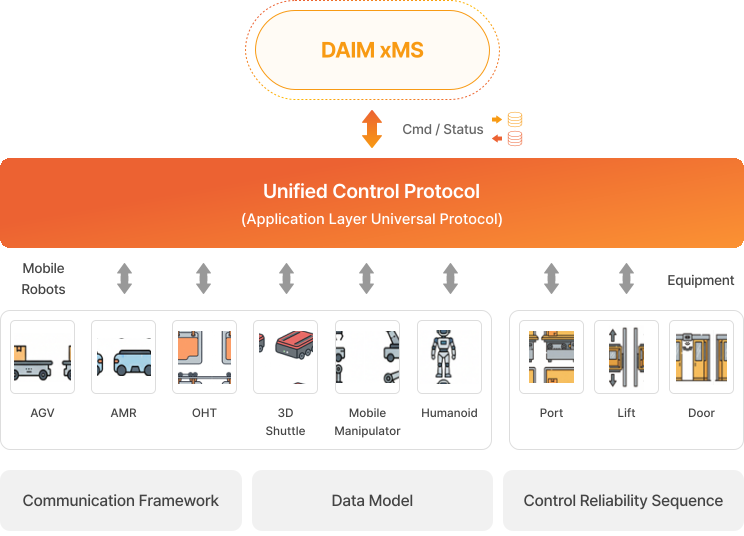
Built on DAIM’s x-Control Protocol (xCP), xMS integrates multi-vendor mobile robots into one control platform through standardised protocols — VCP for mobile robots and LCP (Lift), DCP (Door) and PCP (Port) for factory equipment. Custom adapters integrate robots that do not natively support xCP.

03

Solution Core + Quick Integration

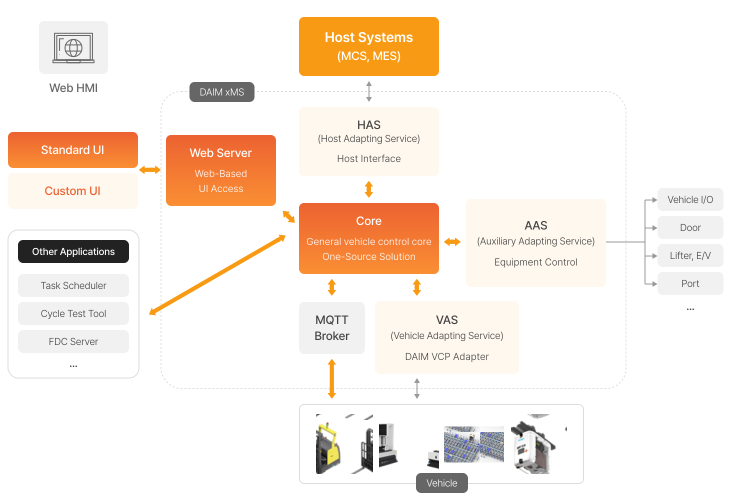
A proven Solution Core with standardised capabilities validated across industries combines with a Custom Module architecture for rapid site-specific customisation, enabling fast, flexible deployment with minimal initial risk.

xMS Universal Fleet Management architecture based on the x-Control ProtocolxMS Solution Core and Custom Module integration architecture

DAIM Technology Project References

Proven results from global manufacturing leaders.

Semiconductor Manufacturing

Challenge
Operating more than 1,000 OHTs, the biggest challenge was managing unexpected congestion. Dozens of engineers monitored the factory around the clock, manually rerouting traffic with limited results.
Solution
Deploying the RL-powered logistics optimisation of xMS, bottlenecks were predicted, traffic was redistributed through dynamic route optimisation and transport tasks were reassigned.
Results
Beyond simply avoiding congestion, xMS predicts and prevents congestion before it occurs, demonstrating a higher level of fleet orchestration.

Battery Manufacturing — Emergency Response

Challenge
In addition to maximising day-to-day efficiency, the system needed to respond reliably to emergencies — such as fire incidents — and urgent orders without disrupting operations.
Solution
A real-time dynamic control algorithm proactively reroutes surrounding robots for urgent orders using priority-based intersection control.
Results
AI autonomously determines the optimal response to unexpected events while maintaining overall system stability and productivity.

Battery Manufacturing — Multi-Vendor Fleet

Challenge
Integrating more than 250 multi-vendor AMRs into a single coordinated system while achieving target KPIs was a significant orchestration challenge.
Solution
Multi-vendor AMRs were integrated through a standardised interface, with predictive deadlock and congestion avoidance algorithms, validated through Digital Twin-based Virtual Commissioning.
Results
Hundreds of multi-vendor robots operate as a single coordinated fleet, with stable operation in complex, large-scale automated environments.

Frequently asked questions

Key questions before deployment.

Yes. xMS enables unified operation of existing AGVs and AMRs through Universal Fleet Management. The existing robots must support an open communication protocol for integration, which THEXRA assesses during consultation.

No. xMS is built on a vendor-independent architecture that supports mixed-fleet operations across multiple robot manufacturers, providing flexibility for future equipment replacement and system expansion.

Yes. Built on a unified multi-vendor robot control architecture, xMS makes it straightforward to expand robot fleets without modifying the existing system as additional robots are introduced.

xMS minimises deployment risk through Digital Twin-based pre-validation and significantly shortens implementation time. Depending on project scope, the manufacturer indicates on-site system integration can typically be completed within two weeks to one month after equipment delivery; every project requires its own assessment.

Yes. xMS provides flexible integration with host systems such as MES, WMS and ERP through standard APIs and interfaces, enabling integrated operations while preserving your existing IT environment.

Yes. In addition to host-system integration, xMS supports lightweight robot call systems, including call stations and PLC-based triggers. System integration can be expanded incrementally as needed.

Still have questions? Talk to THEXRA.

Request Consultation

Deploy xMS with THEXRA.

Discuss your application, existing systems and operating constraints with THEXRA.

Talk to Our Experts