DAIM TECHNOLOGY · PHYSICAL AI PLATFORM

Connect Physical Operations with Digital Intelligence.

xDT — Digital Twin for System X

xDT connects real-world industrial operations with a synchronised Digital Twin, enabling operational monitoring, simulation-based validation and informed robot deployment decisions.

xDT high-fidelity Digital Twin platform
xDT Digital Twin synchronised with real robot operations

Core capabilities

What xDT delivers.

  • High-Fidelity Industrial Digital Twin
  • Synchronisation with xMS
  • Virtual Commissioning
  • Real-Time Robot & Equipment Monitoring
  • Material Flow Analysis
  • Bottleneck Identification
  • Fleet Sizing & Utilisation Evaluation
  • Robot Route & Layout Validation
  • KPI Analysis
  • Operational Scenario Validation

How it works

Inside xDT.

01

Data collection & input

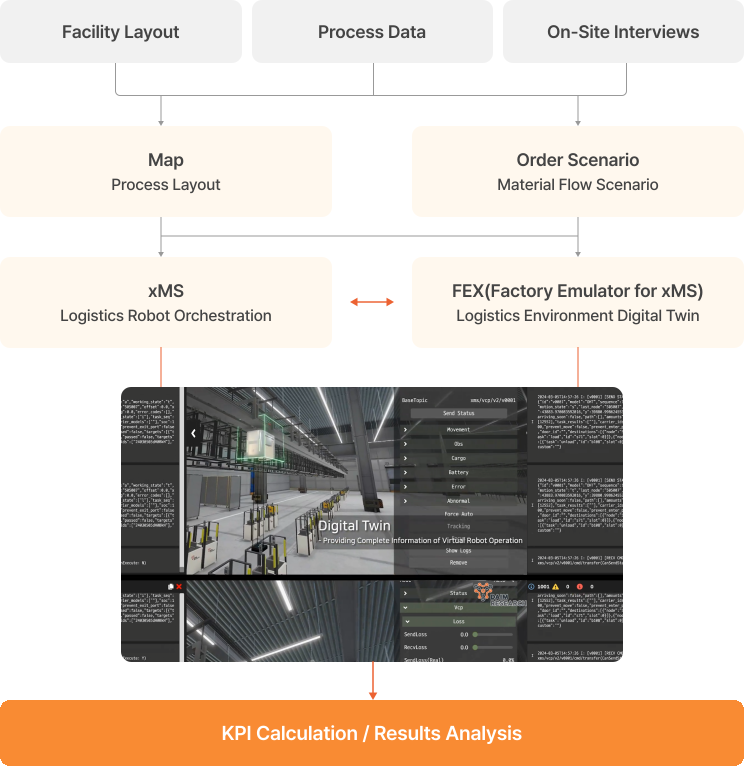
Detailed facility layouts, production process data and real-world constraints are collected through on-site interviews, then used to create a digital map of the production layout and order scenarios representing real material flows.

02

Digital Twin synchronisation

The xMS robot orchestration logic used in the physical environment is replicated within the Digital Twin. FEX (Factory Emulator for xMS) creates a logistics environment that interacts with xMS in real time, reproducing material flows before physical robots are deployed.

03

Virtual simulation & visualisation

Robot movements, traffic congestion and equipment status are monitored in real time within a 3D virtual environment, while control logic execution, simulation logs and runtime data are analysed to verify system accuracy.

04

KPI calculation & results analysis

Simulation results verify system fidelity and calculate KPIs such as throughput, equipment utilisation and logistics efficiency — used to determine optimal robot fleet size, validate operational scenarios and estimate ROI.

xDT real-time synchronisation between the physical environment and the Digital Twin

DAIM Technology Project References

Proven results from global manufacturing leaders.

Large-Scale AGV, AMR & OHT Deployment

Challenge
When deploying large-scale AGV, AMR or OHT systems, it is difficult to predict whether target KPIs such as throughput and lead time can be achieved, and data to determine the optimal fleet size and operating policies is insufficient.
Solution
A virtual logistics automation system replicates the real-world physical environment, operational logic and communication, enabling virtual testing under production conditions across a wide range of scenarios, including material flow changes and equipment failures.
Results
Simulation determined the optimal robot fleet size and specifications required to achieve target KPIs, helping avoid unnecessary investment, and multiple operating policies were evaluated to identify the most efficient strategy.


Elevator Manufacturing

Challenge
Elevator group control algorithms needed to be validated quickly and accurately across diverse passenger traffic patterns without testing in actual buildings.
Solution
A 165× accelerated simulation engine ensured consistent and reproducible results, with control strategies designed and validated using user-defined what-if scenarios covering building configurations, elevator models and passenger traffic patterns.
Results
A full day’s operations were simulated in just 9 minutes, dramatically reducing algorithm testing and validation time, with hundreds to thousands of simulation runs that would be impossible in actual operating environments.

Battery Manufacturing — Remote Validation

Challenge
Limited physical access to overseas factories required remote analysis and validation of production and logistics processes to identify optimisation scenarios that maximise operational efficiency.
Solution
The complex operational logic and physical constraints of core production processes were modelled in a Digital Twin, embedding operational logic from MES, ACS and other production systems into the simulation engine.
Results
Overseas factory operations were analysed remotely in real time, remote implementation feasibility was validated, and high-fidelity simulations evaluated multiple operational scenarios, increasing productivity by up to 3.8%.

Frequently asked questions

Key questions before deployment.

To fully leverage xDT, the xMS logistics robot orchestration platform is deployed first. xMS enables logistics automation, while xDT maximises its operational efficiency. THEXRA can help plan the right sequence for your operation.

A Digital Twin without a clear objective is unlikely to succeed. xDT is designed with a specific purpose: maximising the design and operational efficiency of xMS-based logistics automation systems, synchronising real operational logic with the virtual environment rather than acting as a generic 3D visualisation.

Yes. The simulation capabilities are available as a standalone solution called xSIM. If you would like to start with simulation before committing to full orchestration, xSIM is the ideal starting point.

Still have questions? Talk to THEXRA.

Request Consultation

Deploy xDT with THEXRA.

Discuss your application, existing systems and operating constraints with THEXRA.

Talk to Our Experts